"What would FDR do?"
It was a question former Clintonian Robert Reich asked on Twitter last week regarding to the Supreme Court's looking primed to shoot down "Obamacare." It was yet another unfavorable comparison to former Democratic presidents Obama's received pretty much since the Tea Party emerged in the summer of '09. Why can't Obama be more like FDR? LBJ? Carter? Clinton?
I often answer, especially with the last two, with a "Thank God, he ain't." Here we have a president who's accomplished a bunch of historic shit, who, as Rachel Maddow pointed out a few weeks ago, has come through on 85% of his campaign promises, and, with stiff opposition put universal health care on the books (Yes, I know it's neither perfect nor what everybody clamored for, but, to paraphrase LBJ, "I know it's messed up, but put it on the books. We'll fix it later." That's pretty much how our system works. They put something in place and modify it as time goes by. The Medicare and Social Security that you so prize today ain't what they were when first enacted.). Yet, I constantly hear how Obama's done absolutely nothing, how he's weak (in the face of the Tea Party who goes armed to public meetings talking about revolution and 300 death threats a month), and why can't he be more like the aforementioned presidents.
I blame a lot of it on the economy, of course. Unemployment's high. Insecurity's even higher. Everything else pales in comparison. I can blame the media, the Right Wing propaganda machine, Liberals penchant to whine about everything and their superhuman wobbly-kneed ability to make even their historic successes look like monumental failures. Nostalgia, romanticism. I can blame a whole host of things. But I mainly blame history.
Friday, August 19, 2011
What Would FDR Do?
Labels:
barack obama,
bill clinton,
fdr,
jimmy carter,
lbj
Wednesday, August 17, 2011
Skin
I know I'm late to the game. I always am. But I just finished watching Skin with Sophie Okonedo (a goddess) and Sam Neill (so ubiquitous he's at least a demigod). It's one of those based-on-a-true-story stories about a white couple who give birth to a "dark-skinned" daughter during apartheid-era South Africa.
It's an intriguing flick. It's one of the few movies to ever explore race as a social construct (Black Like Me, Watermelon Man, and, ugh, Soul Man) come to mind. You watch a father's desperate struggle to have his daughter officially recognized by the state as being "white" to glean the advantages that that would garner her while society at large views her as "coloured." Since one's race is basically what one is perceived to be, you can only imagine the consequences. And, of course, it ain't pretty.
I am one who believes that race is, indeed, a social construct. Therefore, I found the movie very interesting and enjoyed it (as much as one can "enjoy" an apartheid flick) for exploring that. Also, as an American, I found it interesting because South Africa's construct of race differs a bit from ours. Having been ruled by the One Drop Rule for the lion's share of this country's existence, we have only relatively recently started to recognize that there's such a thing as a "mixed-race" person. Black is black is black is black. Though the character of this film was categorized as coloured it seemed like she was treated more as a black. Skin has piqued my interest in what the societal and legal differences were/are between black and coloured in South Africa.
It's an intriguing flick. It's one of the few movies to ever explore race as a social construct (Black Like Me, Watermelon Man, and, ugh, Soul Man) come to mind. You watch a father's desperate struggle to have his daughter officially recognized by the state as being "white" to glean the advantages that that would garner her while society at large views her as "coloured." Since one's race is basically what one is perceived to be, you can only imagine the consequences. And, of course, it ain't pretty.
I am one who believes that race is, indeed, a social construct. Therefore, I found the movie very interesting and enjoyed it (as much as one can "enjoy" an apartheid flick) for exploring that. Also, as an American, I found it interesting because South Africa's construct of race differs a bit from ours. Having been ruled by the One Drop Rule for the lion's share of this country's existence, we have only relatively recently started to recognize that there's such a thing as a "mixed-race" person. Black is black is black is black. Though the character of this film was categorized as coloured it seemed like she was treated more as a black. Skin has piqued my interest in what the societal and legal differences were/are between black and coloured in South Africa.
Labels:
apartheid,
sam neill,
skin bleaching,
sophie okonedo
Thursday, June 16, 2011
Old School -- A Hip-Hop Haiku
Wednesday, June 15, 2011
A Fatherhood Haiku
In honor of Tyrese's fatherhood poem, I have been bitten by the poetry dung beetle and have decided to write my own haiku. I hope you enjoy.
Condom broke, I'm broke
Shitty diapers, mortgage due
I'm a proud father
Monday, May 23, 2011
How to Become a Skinny White Chick
In the proud tradition of Madame C.J. Walker, Dove announces a miracle bath product that will ... well, take a look for yourself.
I hear it's selling like hot cakes beef patties down in Jamaica.
Wednesday, May 18, 2011
Less Attractive Than Whom?
You may have heard this already, but yesterday Psychology Today posted yet another "scientific" study on the inherent inferiority of the African "race." Apparently, some dude pulled a PhD diploma out of his ass Lucky Charms cereal and asked "Why Are Black Women Less Attractive"?
The London School of Economics- and Birckbeck College-affiliated "evolutionary psychologist," Dr. Satoshi Kanazawa proves that he himself and his supposedly scientific field has not much evolved beyond the--I thought--discredited field of social Darwinism. Apparently, his phrenological study on how the Negro has smaller brain capacity and, therefore, cannot attain high levels of intellect nor responsibility was thrown out by P.T. His empirical study on how the Negro cannot possibly experience pain was dismissed after one Negro on P.T.'s Board promised to inflict pain if the study was published.
But our intrepid Dr. Kanazawa would not be deterred. After all, it is science's duty to, every few years, show without a scientific doubt that melanin superiority necessarily equates to every-damned-thing-else inferiority. So now, the good doctor pressed a new wrinkle into the African Inferiority Debate (A.I.D.): Testosterone.
According to Doctor Kanazawa, the Negro has an overabundance of testosterone, which somehow makes the Negress less attractive than women of other races while the Negro male remains just as adorable as all the other men out there. Oddly enough, during the turn of the last century, it was the Negro's overabundance of testosterone that made him especially susceptible to the effects of cocaine--turning his darky, little brain mad and turning the colored into a wild, growling, jungle beast whose muscles, already genetically honed for hard labor, became superhuman in strength, leading to an animal frenzy that had to be beaten into submission (you know, like Rodney King).
I guess with evolutionary psychologists ... the more things change the more they stay the same.
The London School of Economics- and Birckbeck College-affiliated "evolutionary psychologist," Dr. Satoshi Kanazawa proves that he himself and his supposedly scientific field has not much evolved beyond the--I thought--discredited field of social Darwinism. Apparently, his phrenological study on how the Negro has smaller brain capacity and, therefore, cannot attain high levels of intellect nor responsibility was thrown out by P.T. His empirical study on how the Negro cannot possibly experience pain was dismissed after one Negro on P.T.'s Board promised to inflict pain if the study was published.
But our intrepid Dr. Kanazawa would not be deterred. After all, it is science's duty to, every few years, show without a scientific doubt that melanin superiority necessarily equates to every-damned-thing-else inferiority. So now, the good doctor pressed a new wrinkle into the African Inferiority Debate (A.I.D.): Testosterone.
According to Doctor Kanazawa, the Negro has an overabundance of testosterone, which somehow makes the Negress less attractive than women of other races while the Negro male remains just as adorable as all the other men out there. Oddly enough, during the turn of the last century, it was the Negro's overabundance of testosterone that made him especially susceptible to the effects of cocaine--turning his darky, little brain mad and turning the colored into a wild, growling, jungle beast whose muscles, already genetically honed for hard labor, became superhuman in strength, leading to an animal frenzy that had to be beaten into submission (you know, like Rodney King).
I guess with evolutionary psychologists ... the more things change the more they stay the same.
Thursday, May 12, 2011
Damn ...
I just read this last night in Hoodlums: Black Villains and Social Bandits in American Life by William L. Van Deburg and needed to share it.
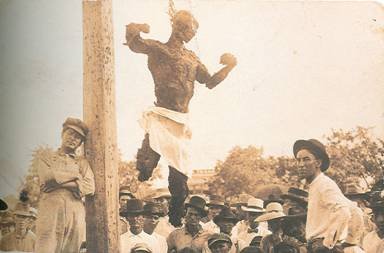
"In the five decades between the end of Radical Reconstruction and the start of the Great Depression, more than 3,200 black men, women, and children were executed by southern mobs. Few of the perpetrators were brought to justice, fewer still punished for their crimes. Evidencing a marked June-to-August seasonality and heavily concentrated in the "Black Belt" running through Georgia, Alabama, Mississippi, and Louisiana, this plague of lynching fever peaked during the 1890s, went into remission during World War I, reappeared in the early 1920s, and experienced a final decline during the 1930s. Despite the best efforts of the reform press, the black pulpit, and groups such as the Commission on Interracial Corporation and the NAACP, vigilante 'justice' was meted out to a black victim nearly once a week, every week between 1882 and 1930."
Labels:
hoodlums,
lynching,
racism,
william l. van deburg
Subscribe to:
Posts (Atom)